Color as Path to the Spirit
On the 15th of August, Italy celebrates Ferragosto, a day of summer, rest and celebration whose roots reach back to the Roman Feriae Augusti. Over time, the ancient summer festival became inseparably connected with the Christian Feast of the Assumption of Mary.
At the height of summer, when the earthly world is at its fullest in light and colour, we encounter an image of ascent from Earth towards the heavens.
Few paintings express this movement as powerfully as Titian’s Assumption of the Virgin, created for the Frari church in Venice. The painting unfolds vertically in three luminous stages: the dark, earthbound world of the apostles; Mary rising between Earth and Heaven; and, above, a radiant realm where colour almost dissolves into light.
What makes Titian’s Assumption especially fascinating is that the movement is created through colour itself.
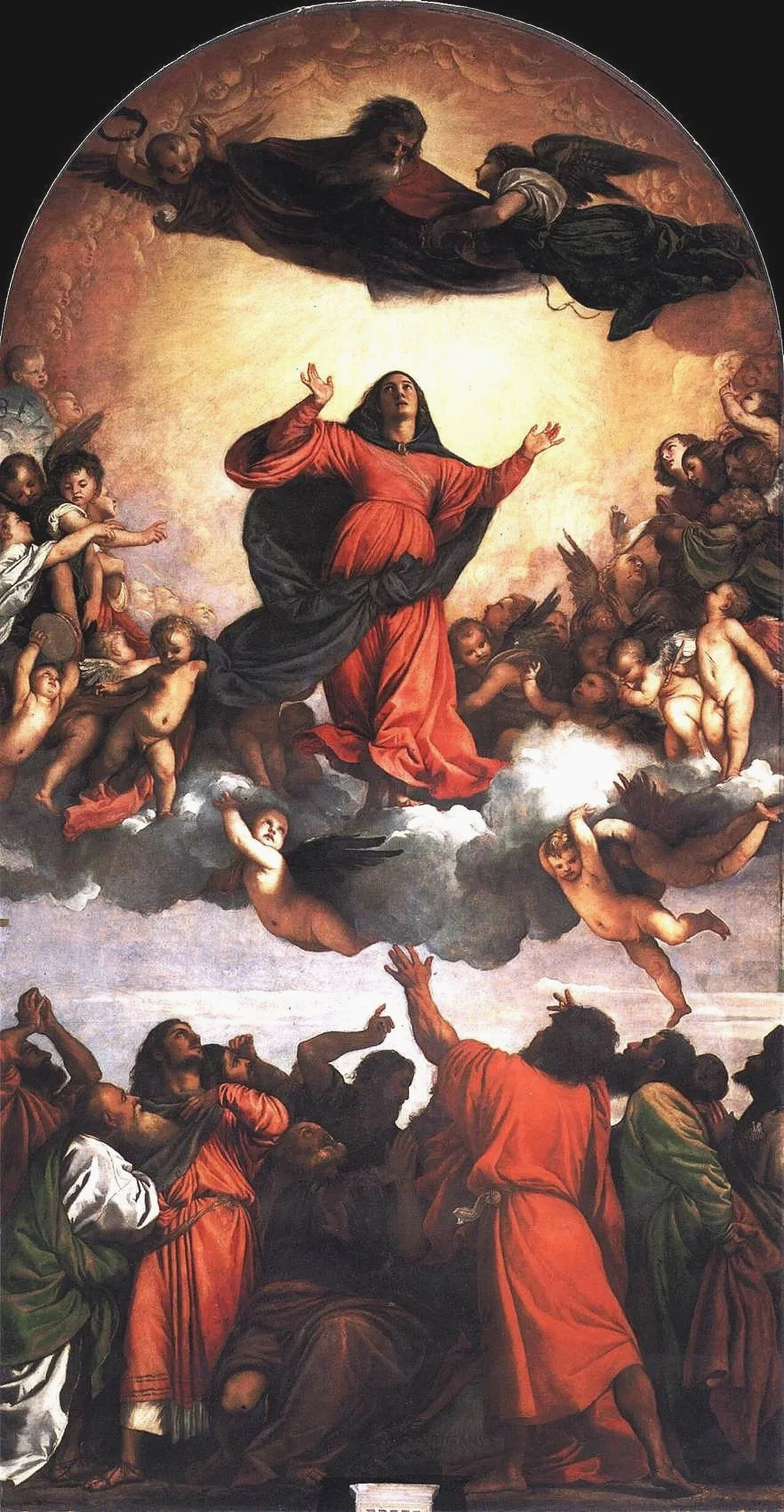
Titian - Assumption of the Virgin - 1516-1518 - Basilica di Santa Maria Gloriosa dei Frari - Venice
In his 9 June 1923 lecture on Titian, later included in The Essence of Color (GA 291), Rudolf Steiner wrote that “the drawing” should be born from colour rather than colour simply filling an already established form. He described Titian’s painting as a place where one can experience the three worlds through their colour relationships: the darker colours below, Mary in the intermediate realm, and the increasing luminosity above.
Steiner also draws attention to Mary’s traditional red and blue: red carrying something of the earthly and emotional, blue opening toward the soul and the spiritual. Yet the real artistic experience does not lie in decoding these colours as symbols. It lies in their living relationship with light and darkness.
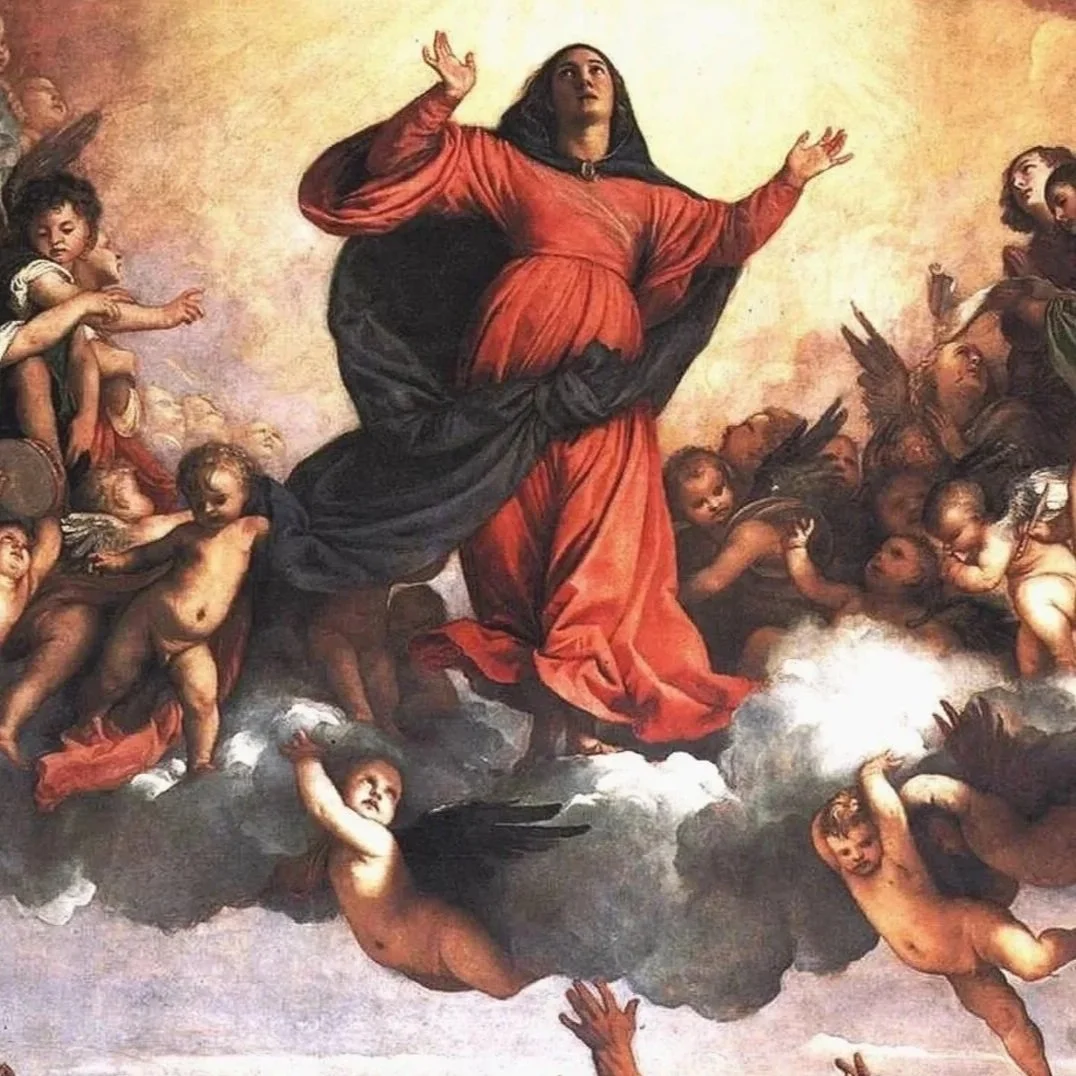
Titian - Assumption of the Virgin - 1516-1518 - Basilica di Santa Maria Gloriosa dei Frari - Venice
This is what makes Titian so extraordinary. The red does not merely represent Mary; it moves.
The blue does not merely surround her; it opens space.
Light does not simply illuminate the figures: it transforms them.
The earthly world remains present in the vibrant green, but it is no longer heavy. The darkness below becomes the starting point of the ascent.
Perhaps this is why the Assumption can speak so directly even before we know anything about its theology or art history.
We encounter the colour first. We feel its movement, its intensity, its rhythm. Only afterwards do we begin to understand.
And this brings us back to Ferragosto.
The 15th of August holds together two apparently different gestures: the celebration of the fullness of summer and the image of ascent. One looks into the earthly world; the other looks beyond it. Yet in the reale of the Soul they both share a dream-like state of consciousness.
In a similar way Titian’s colours hold these two movements together.
At the height of summer, Earth becomes colour, and colour becomes a threshold toward light.
Perhaps this is the quiet invitation of the Assumption: not to leave the earthly world behind, but to experience it so fully that, through colour, we begin to perceive another dimension within it.
Ferragosto becomes a threshold between Earth and Heaven, between colour and light, between what we see and what we may begin to perceive.